Robocode AI: A Rule-Based System Implementation
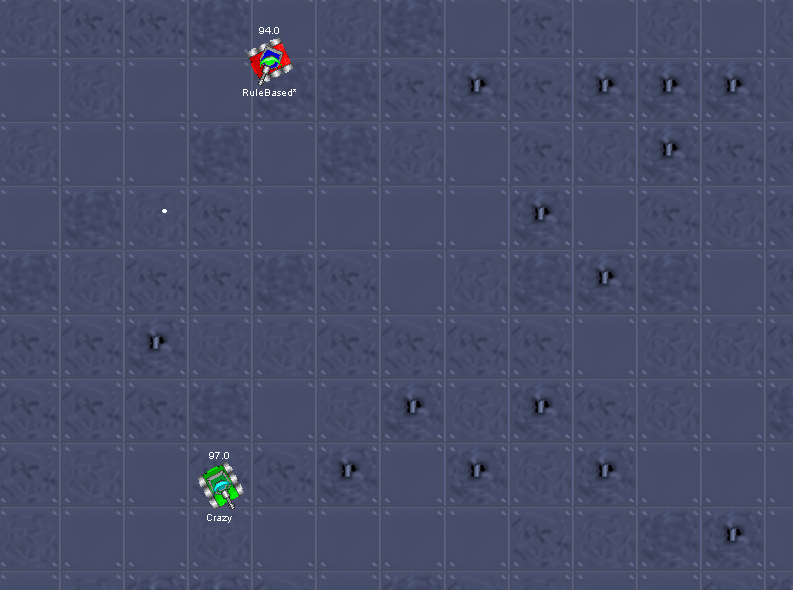

About this project
This project is an implementation of a rule-based system in Java, based on the framework described in Artificial Intelligence for Games, 2nd Edition by Ian Millington and John Funge. Rule-based systems represent knowledge as a set of IF-THEN rules that operate on facts stored in databases. The system matches rules to facts and triggers actions when conditions are satisfied. My implementation demonstrates rule-based reasoning applied to a computer-controlled player, showing both the benefits and limitations of this approach.
Implementation Details
The core design centers on the Database and it’s supporting classes (DataNode, DataGroup, Datum) which manage facts and organize them into a structured knowledge base. Matches are structured similarly to the data in the database, with identifiers allowing the rule based iteration to find appropriate groups and evaluate conditions. This system drives the reasoning process by checking conditions, applying matching rules, and updating the database accordingly. This design allows logic such as: If the enemy has been located and my previous move has finished then move to the next location away from the enemy. The result is a working demonstration of rule based decision making applied to a computer controlled player.
Lessons Learned
In practice, the system provided several advantages: cleaner and more modular code, sensible logic, and tight control over AI behavior. Separating matching patterns into their own class and using helper functions to create the rules kept the implementation readable and maintainable. However, I also encountered limitations such as single-action execution, equal-priority decision making, and lack of parallel sequencing. To address this, I introduced a priority level to rules, (executing the highest-priority action among matching rules) and categorizing rules into movement and combat, which allowed both types of behavior to run in parallel. While this increased processing time (minimal given the scope of my AI program), it resulted in more realistic AI behavior and demonstrated how rule- based systems can be refined for game applications.